
Senior Deep Learning/AI Engineer, Illumina AI Lab
Kuan-Hao Chao
I build models and tools to understand how genomes work.
I’m a Senior Deep Learning/AI Engineer at the Illumina AI Lab. I develop machine-learning models and open-source software to understand gene regulation, RNA splicing, and the effects of genetic variation. My work spans sequence-to-function modeling and DNA language models, alongside methods for genome annotation and pangenome analysis.
I earned my Ph.D. in Computer Science from Johns Hopkins University in August 2025, advised by Steven Salzberg and Mihaela Pertea at the Center for Computational Biology. I also hold a B.S. in Electrical Engineering from National Taiwan University.
About my name趙冠豪
趙冠豪 is my Chinese name. My first name consists of two words, Kuan (冠) and Hao (豪), connected with a hyphen. Kuan (冠) means ‘crown’, and it can also be used as a verb describing the action of ‘putting A on top of B’, which implies ‘being a champion’. Hao (豪) means ‘big’ and ‘grand’, signifying ‘having the characteristics of a hero’. When combined, Kuan-Hao (冠豪) represents the love and expectations my parents have for me. My last name is Chao (趙), and an interesting fact is that Chao was the surname of 18 emperors from the ancient and prosperous Song Dynasty in China (A.D. 960 – A.D. 1279).
Also written as Kuan-Hao Chao, Kuan Hao Chao, or Kuanhao Chao — and, family name first, Chao Kuan-Hao (趙冠豪).
Pronunciation Kuan-Hao Chao — say it like “kwan-how chow” (Kuan rhymes with “swan”; Hao and Chao both rhyme with “now”).
Hear me say it
type
help ls grep askScroll output with a mouse wheel, trackpad, or swipe. Press Shift-PageUp or Shift-PageDown to move through history. Tab completes commands; the arrow keys move through command history.open full shell →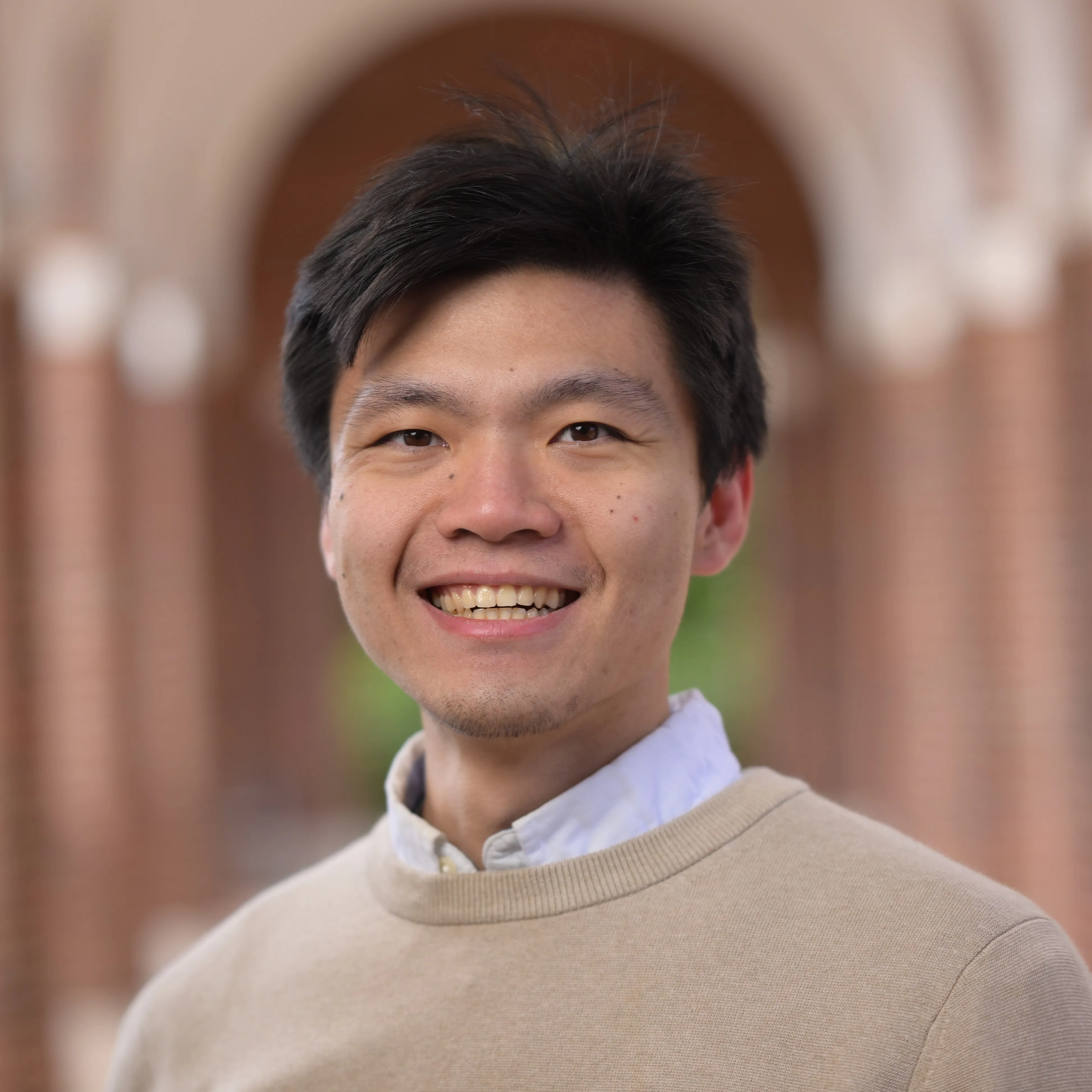
What I work on
Research
Selected work
Publications
Open source
Featured software
 ShorkieYeast RNA-Seq coverage predictor powered by a fungal DNA language model.
 OpenSpliceAIEfficient, modular splice-site prediction framework — easy to retrain on non-human species.
 LiftOnGenome-annotation lift-over tool that combines DNA and protein alignments.
 SplamDeep-learning splice-site predictor that improves spliced alignments.
Background
Experience & education
Experience
- Aug 2025 – PresentSenior Deep Learning/AI EngineerIllumina, AI Lab
- May 2024 – Aug 2024Genomics ML Research InternCalico Life Sciences, Kelley Lab
- Jul 2020 – Jan 2021Research AssistantAcademia Sinica, Institute of Information Science
- Jul 2019 – Jun 2020Research StudentAustralian National University, Research School of Biology
- Aug 2018 – Jul 2019Research StudentNational Taiwan University, Centers of Genomic and Precision Medicine
Education
- Sep 2021 – Aug 2025Ph.D., Computer ScienceJohns Hopkins University
- Sep 2021 – May 2023M.S.E., Computer ScienceJohns Hopkins University
- Sep 2016 – Jan 2021B.S., Electrical EngineeringNational Taiwan University
Writing
Posts
A complete diploid human genome: the T2T-HG002 benchmark and its gene annotation
The T2T Consortium finished both haplotypes of HG002 and released them as a benchmark. What the paper shows, how the two haplotypes were annotated, and the step of that annotation I contributed.
Read postShorkie: learning yeast regulatory code from related fungi
Shorkie tests how fungal pretraining, evolutionary scale, and fine-tuning on yeast regulatory assays help a compact DNA model read expression and variant effects.
Read postUpdates
Recent news
SpliceCOV published in Genes
Congratulations to Celine Hoh and the team on SpliceCOV, now published in Genes! SpliceCOV uses supervised learning to filter noisy splice sites and transcript…
Read updateSpliceAI2: quantitative splicing and transcript prediction
I'm honored to have been part of the SpliceAI2 team, and grateful to Kishore Jaganathan for the opportunity.
Read updateT2T Consortium Q100 diploid human genome benchmark is published in Cell
It was an honor to take part in the Telomere-to-Telomere Consortium's Q100 project, whose complete diploid HG002 genome benchmark is published in Cell. My contribution…
Read updateI give an invited seminar at Academia Sinica
I gave an invited seminar, "Decoding the Language of Genomes: Bridging Sequences and Function through Deep Learning," at the Agricultural Biotechnology Research Center…
Read updateInteractive Genome Browser
The yeast genome under Shorkie_LM
Benchmark Loci:
chrVII:882,012–884,610
Let's work together
I'm always glad to talk about computational genomics, machine learning, or mentoring research projects. Reach out anytime.