Splam generalizes on non-human species
If you are considering improving your non-human RNA-Seq alignment files or transcript assemblies and wondering whether Splam is the right tool to use, this page provides the answer!
In short, the answer is Yes ✅!
You can perform the same analysis as described in the Alignment file evaluation & cleanup (BAM) and Annotation file / assembled transcripts evaluation (GFF) pages. All you need is the (1) genome and (2) alignment files or annotation files of the species you are interested in.
Below is a simple example to show Splam works on mouse and a detailed explanation on how well Splam works on non-human species.
Example: Running Splam on house mouse (Mus musculus)
In this example, we will be scoring the full GRCm39 assembly of mouse chromosome 19. The steps are basically the same as the human example, which you should check out first. For brevity, we only summarize the main code here; detailed explanations about each step are available in the human example.
Step 1: Preparing your input files
For non-human species, you need the same three inputs used in the human analysis workflow: an annotation, its matching reference genome, and the Splam model.
Input files
An annotation file in
GFForGTFformat [example file: mouse_chr19_subset.gff].A reference genome in
FASTAformat [example file: mouse_chr19.fa].The Splam model, which you can find here: splam.pt
Step 2: Extracting introns in your annotation file
In this step, you take an annotation file (1) and run
splam extract mouse_chr19_subset.gff -o tmp_out_generalization
This gives you a BED file with the extracted introns in tmp_out_generalization/junction.bed.
Step 3: Scoring extracted introns
In this step, the goal is to score all the extracted splice junctions. You will need three files: (1) the BED file generated in Step 2, (2) the matching reference genome, and (3) the Splam model. Once these files are in place, run:
splam score -G mouse_chr19.fa -m ../model/splam_script.pt -o tmp_out_generalization tmp_out_generalization/junction.bed
This gives you a BED file with the scored introns in tmp_out_generalization/junction_score.bed.
Step 4: Evaluating isoforms by Splam scores
To summarize the quality of each isoform, users can count how many spurious splice junctions are present in each transcript and calculate the ratio of bad splice junctions among all introns within each transcript by running the following Splam command:
splam clean -o tmp_out_generalization -t 0.8
This gives you a cleaned GFF file at tmp_out_generalization/cleaned.gff.
Explanation: Splam’s performance on non-human species
Although Splam was trained on human datasets, we have shown that the model is able to generalize to other eukaryotic genomes, including plants. In our investigation, we tested the performance of Splam on the Chimpanzee (Pan troglodytes), Mouse (Mus musculus), and Thale cress, a flowering plant (Arabidopsis thaliana), genomes. We report that Splam outperforms SpliceAI in recall, precision, and accuracy, on every score threshold for every species.
Data curation
For each species, we curated our positive and negative datasets similar to the Positive-MANE and Negative-Random strategies from Behind the scenes. The positive dataset was generated from the complete RefSeq/TAIR annotation files downloaded from NCBI, where we extracted the introns from every transcript, filtered out poor annotations, and saved the remaining ~200k as splice junctions. The negative dataset was generated by randomly selecting variable-length canonical GT-AG pairs from the opposite strand of protein-coding genes.
For both datasets, we randomly sampled 25,000 splice junctions and ran Splam and SpliceAI on them to compare results.
Key findings
We find that Splam is able to quickly and accurately classify positive and negative samples, even in species as distant as plants (Arabidopsis thaliana). For the positive samples, Splam correctly classified the vast majority with a high score, whereas SpliceAI struggled more, particularly with Arabidopsis. Moreover, we find that Splam is decisive, with medians values for all three species at 1.0, while SpliceAI’s distribution is more evenly spread (Figure 4).
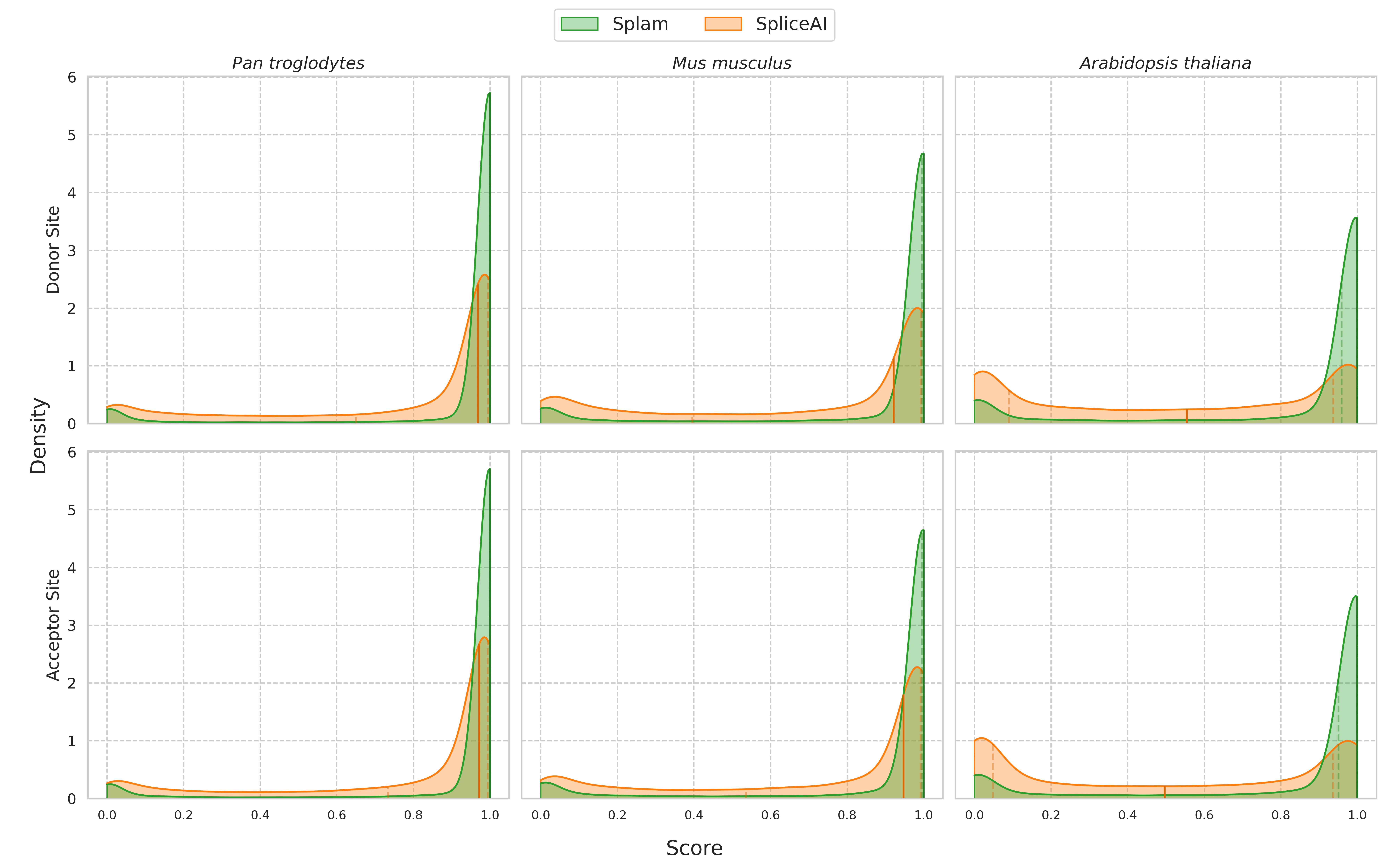
Figure 4 A comparison of the score distributions between Splam (green) and SpliceAI (orange) for the positive dataset. The top row represents donor site scores and the bottom row represents acceptor site scores. The darkened vertical line through the distribution represents the median value, while the two dotted vertical lines represent the first and third quartiles. Splam demonstrates the ability to correctly score positive samples highly, with a peak near 1.0 for all three species. SpliceAI’s distributions are more spread out, especially for Arabidopsis, which exhibits an M-shaped distribution.
Combining this result with the negative data, we calculate summary statistics that help us gauge the performance of Splam at various thresholds. We observe that the recall/sensitivity, precision, and accuracy of Splam outperform SpliceAI at every score threshold for every species, visualized in Figure 5. Additionally, the figure demonstrates Splam’s consistency across a wide range of score thresholds.
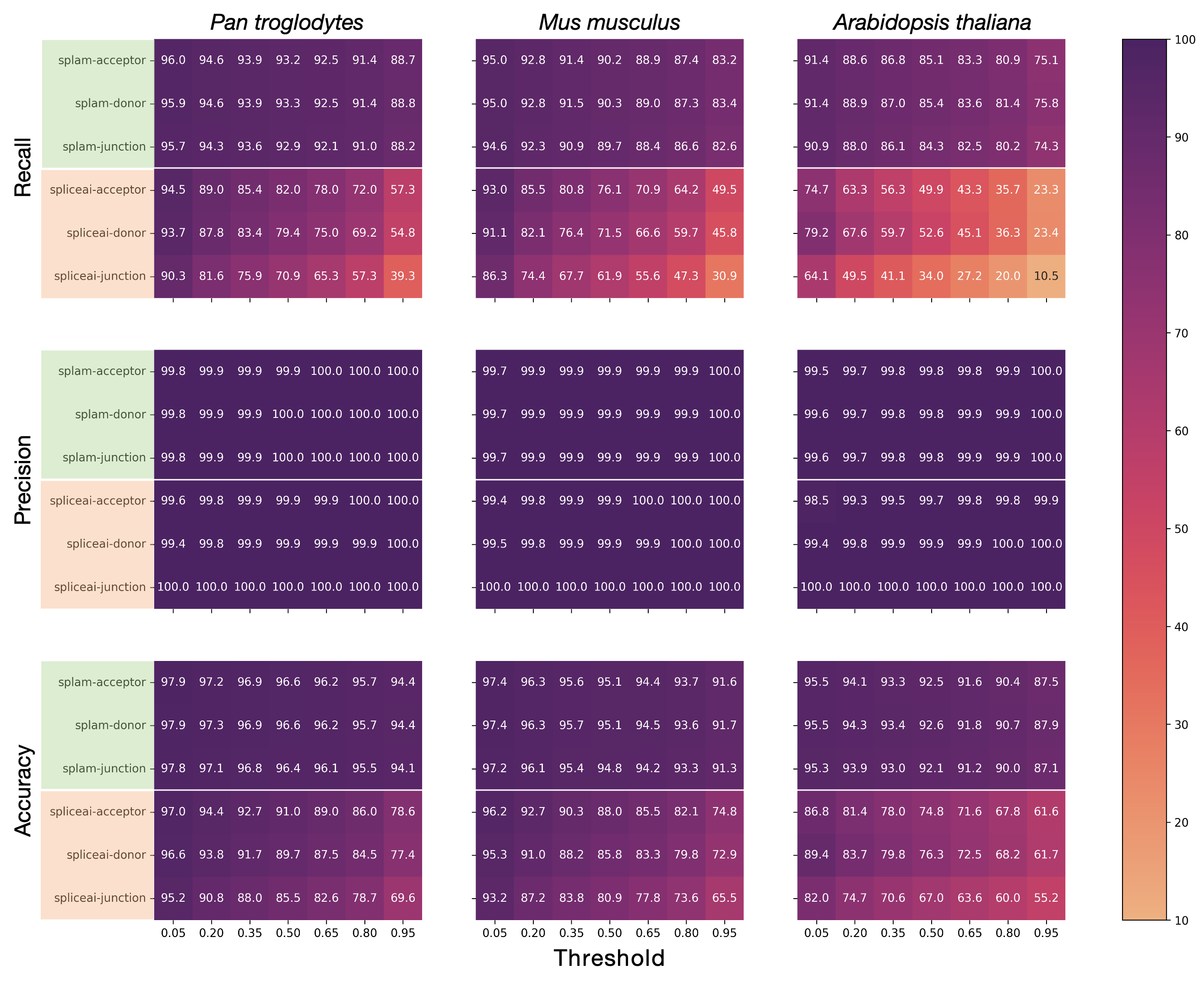
Figure 5 A grid of heatmaps portraying the recall (top), precision (middle), and accuracy (bottom) of both models on the chimpanzee (left), mouse (middle), and Arabidopsis (right) genomes, across a variety of score thresholds (x-axis). For each heatmap, the top three rows (green) represent Splam, and the bottom three rows (orange) represent SpliceAI, where each is examined at the donor, acceptor, and splice junction levels. The performance metrics are reported as percentages on the heatmap. We observe that Splam exhibits consistently high recall and accuracy whereas SpliceAI’s swiftly declines with increasing score thresholds. Precision for both models is consistently high.
The results of this investigation demonstrate Splam’s ability to generalize well on non-human species, including both animal and plant genomes. Additionally, we show Splam performing consistently and accurately on a wide range of score thresholds.

