Benchmarks (v1.0.10)
LiftOn v1.0.10 was evaluated against the two single-method signals it fuses — Liftoff (DNA / minimap2) and miniprot (protein) — and against the previous stable release LiftOn v1.0.8, in a four-way comparison spanning 17 whole genomes and 23 curated subsets across four evolutionary-distance tiers (same species → close → distant → very distant). Every annotation is re-scored with the same tool-neutral metric (Parasail global protein alignment; see the evaluation metrics page), so all four are compared on an even footing.
The full analysis — including the joint recall-vs-identity (apples-to-apples) breakdown and per-genome tables — is in the LiftOn v1.0.10 technical report and the peer-reviewed Genome Research paper.
Accuracy
Across all 17 whole genomes, LiftOn v1.0.10's mean protein identity is above the DNA-only Liftoff on every genome, by +0.0007 on same-species Arabidopsis up to +0.098 on tomato→potato. On Drosophila it reaches 0.922, ahead of miniprot (0.913) and Liftoff (0.887). Against the previous release it is at or above v1.0.8 on every one of the twelve genomes both versions completed — strictly higher on eleven, tied on *Drosophila*→bee — with no fractional dip anywhere.
One result is worth stating plainly rather than averaging away. Comparing LiftOn to miniprot on the transcripts both recover — the only confound-free comparison — LiftOn's per-transcript advantage is real and peaks on the distant tier (+0.024 to +0.035 on dog→cat, human→macaque, human→marmoset), but it reverses on four of the five very-distant genomes. At extreme divergence LiftOn delivers high-precision refinement of the DNA-anchored core it can reach, not higher recall; the default-ON miniprot-only rescue is what narrows the recall gap, and it is deliberately frozen off in these tables so the engine comparison stays apples-to-apples.
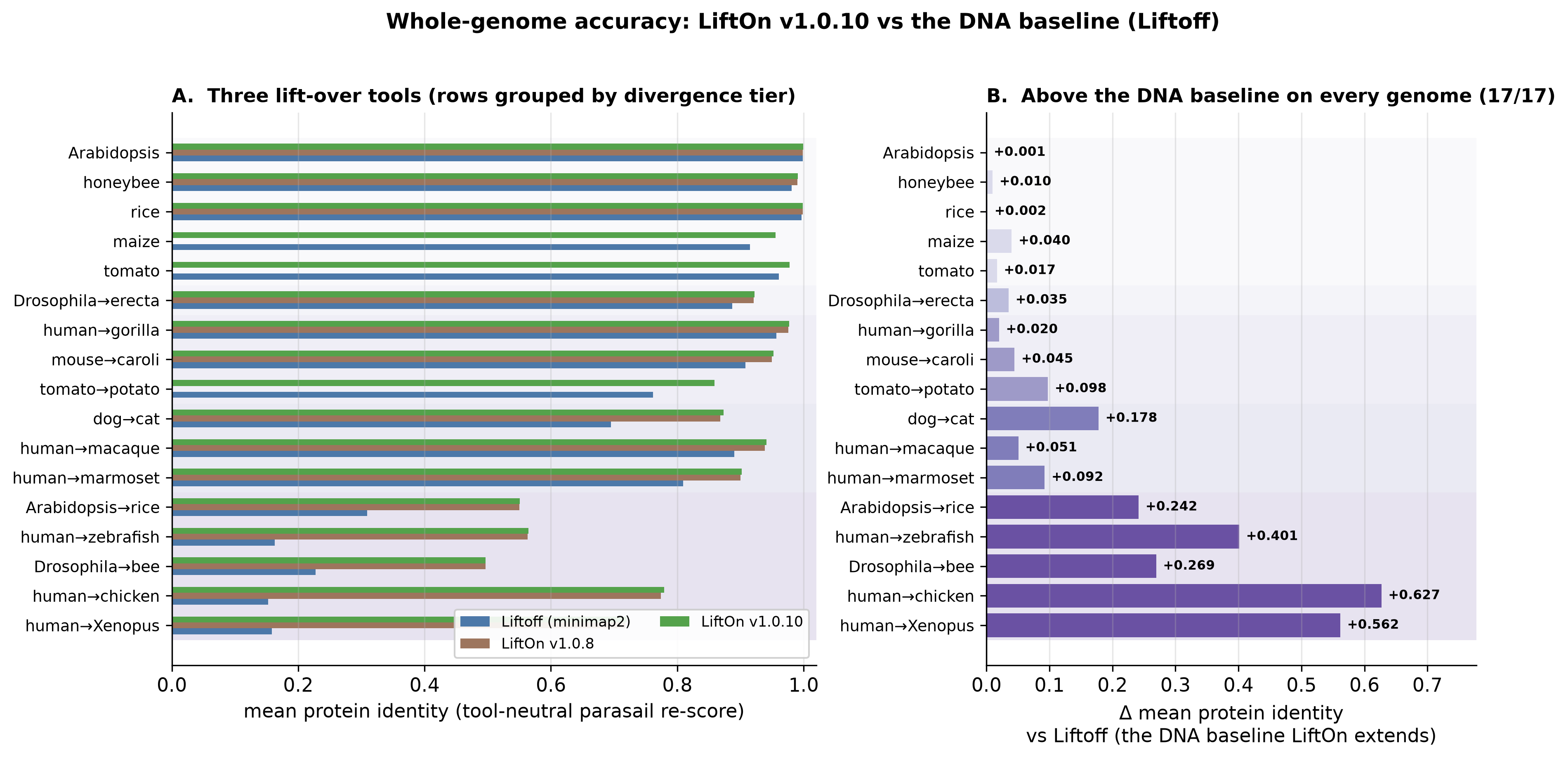
Figure 61 Whole-genome mean protein identity (tool-neutral Parasail re-score). A: LiftOn v1.0.10 vs Liftoff, miniprot, and LiftOn v1.0.8 on every full genome. B: the gain over the DNA baseline, which widens with divergence.
Completeness & robustness
The single largest practical advance is finishing genomes v1.0.8 could not. On five of the seventeen, v1.0.8 aborts mid-run. On full RefSeq Arabidopsis and rice it leaves a partial annotation; v1.0.10 completes both — Arabidopsis 28.2% → 99.9% coding completeness (+34,589 transcripts) and rice 77.3% → 99.9% (+9,594). On maize and the two tomato pairs v1.0.8 produces no scorable annotation at all, while v1.0.10 completes each (96.5%, 99.5%, 93.0%).
A separate write-path fix has the same character: on dog→cat, one transcript with inverted coordinates used to abort the whole run at 11,048 of ~61,000 transcripts. That one feature is now dropped with a logged warning and the genome completes (61,277 transcripts, 98.0% complete).
The default gene-like lift additionally recovers reference feature types the
older gene-only lift dropped — on full Arabidopsis that adds +4,816
pseudogenes, +2,681 lnc_RNAs, plus tRNAs, ncRNAs, snoRNAs and more.
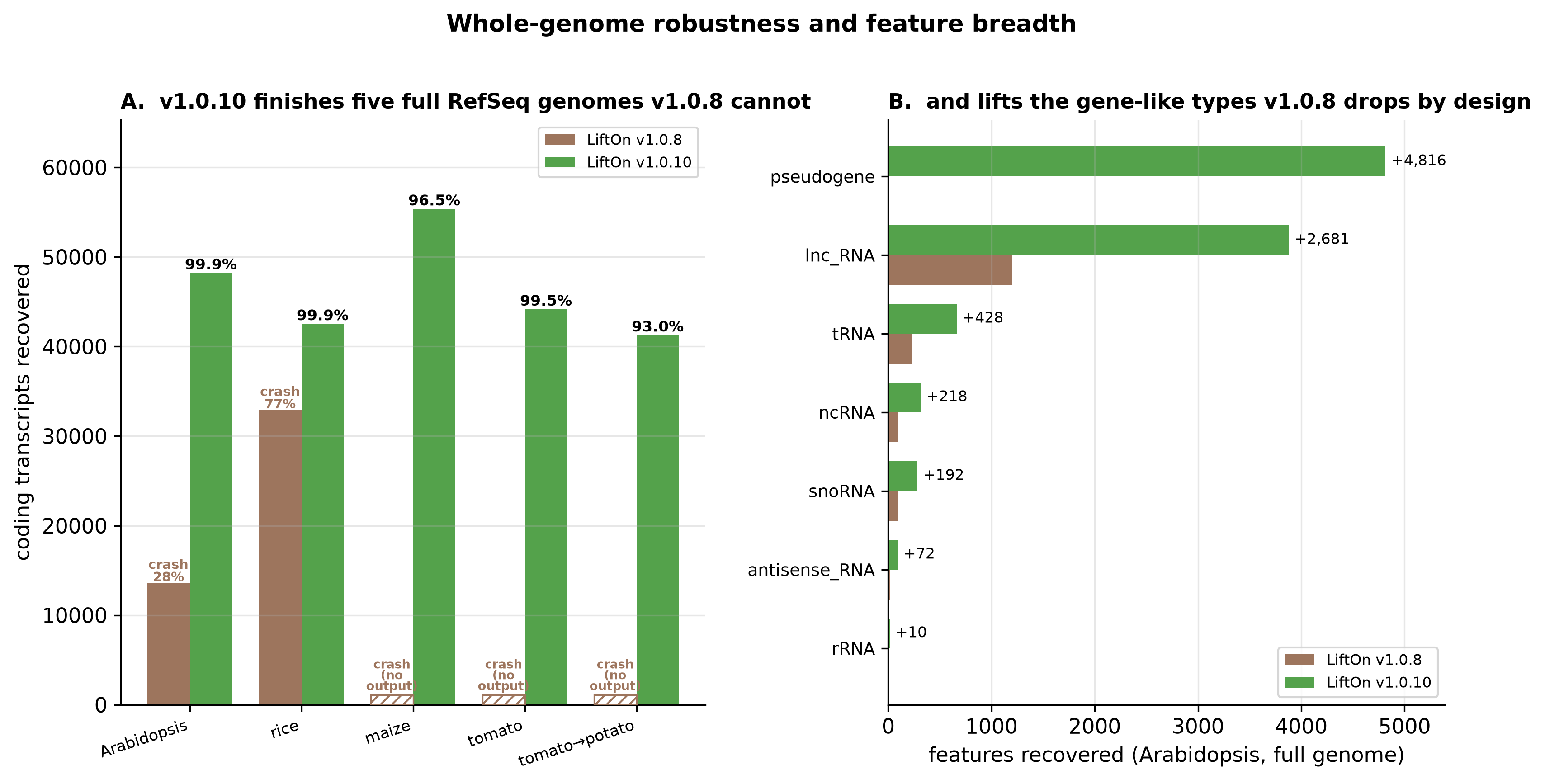
Figure 62 A: coding transcripts recovered on the five full genomes v1.0.8 fails on; v1.0.10 completes all five. B: gene-like feature types recovered by v1.0.10 that v1.0.8 drops by design (full Arabidopsis).
At the largest evolutionary distances, completeness becomes a deliberate precision–recall trade-off: miniprot's protein search is not DNA-anchored and recovers more loci at lower per-transcript identity, while LiftOn keeps Liftoff's DNA-anchored structure and fills genuinely-missing genes with the miniprot-only rescue pass. The technical report breaks this down with a recall-weighted metric.
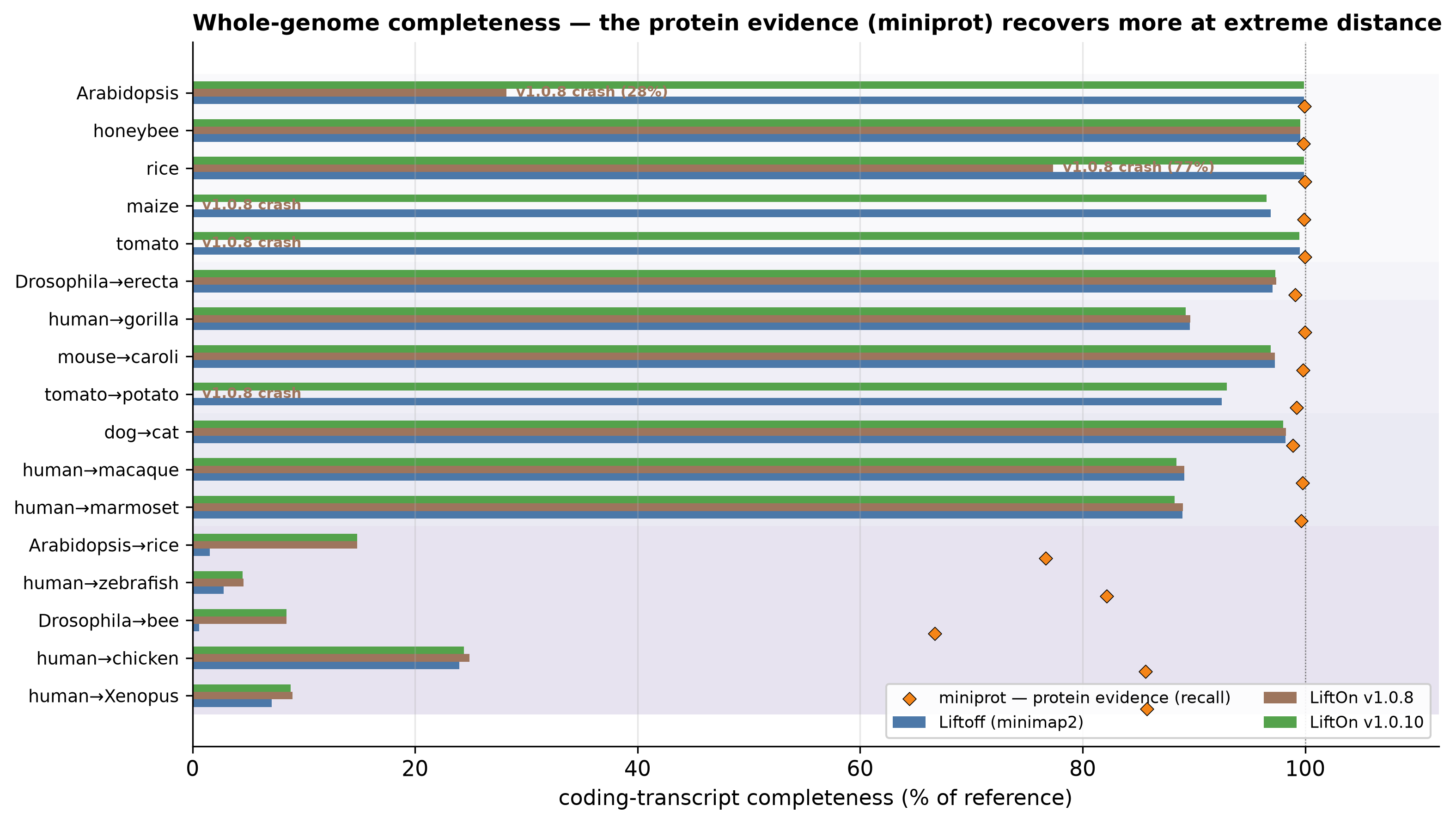
Figure 63 Coding-transcript completeness (% of reference) for all four tools. LiftOn v1.0.10 completes every genome and tracks Liftoff closely; at the very distant tier miniprot trades identity for recall.
GFF3 validity
v1.0.10 makes the emitted annotation validate clean. Default exon/CDS
containment normalization and unique-exon-ID guarantees remove the
LiftOn-introduced errors earlier versions emitted — errors the reference
annotations themselves do not have. Measured with the in-tree gff3-validate:
v1.0.10 reports 0 validation errors on 9 of the 17 whole genomes (bee, Drosophila, all six human cross-species lifts, and Drosophila→bee).
It emits fewer errors than the DNA-only Liftoff on all 17, and is dramatically cleaner than v1.0.8 on every genome both produced — Drosophila 150 → 0, bee 103 → 0, human→gorilla 128 → 0, dog→cat 159 → 11.
The residuals on organellar-gene-bearing plant genomes are reference-inherited, not LiftOn-introduced: they are mitochondrial/plastid genes with CDS directly under
gene, plus duplicate organellar IDs. The TAIR10 Arabidopsis reference itself carries 159 such errors — more than LiftOn's lifted output (49).
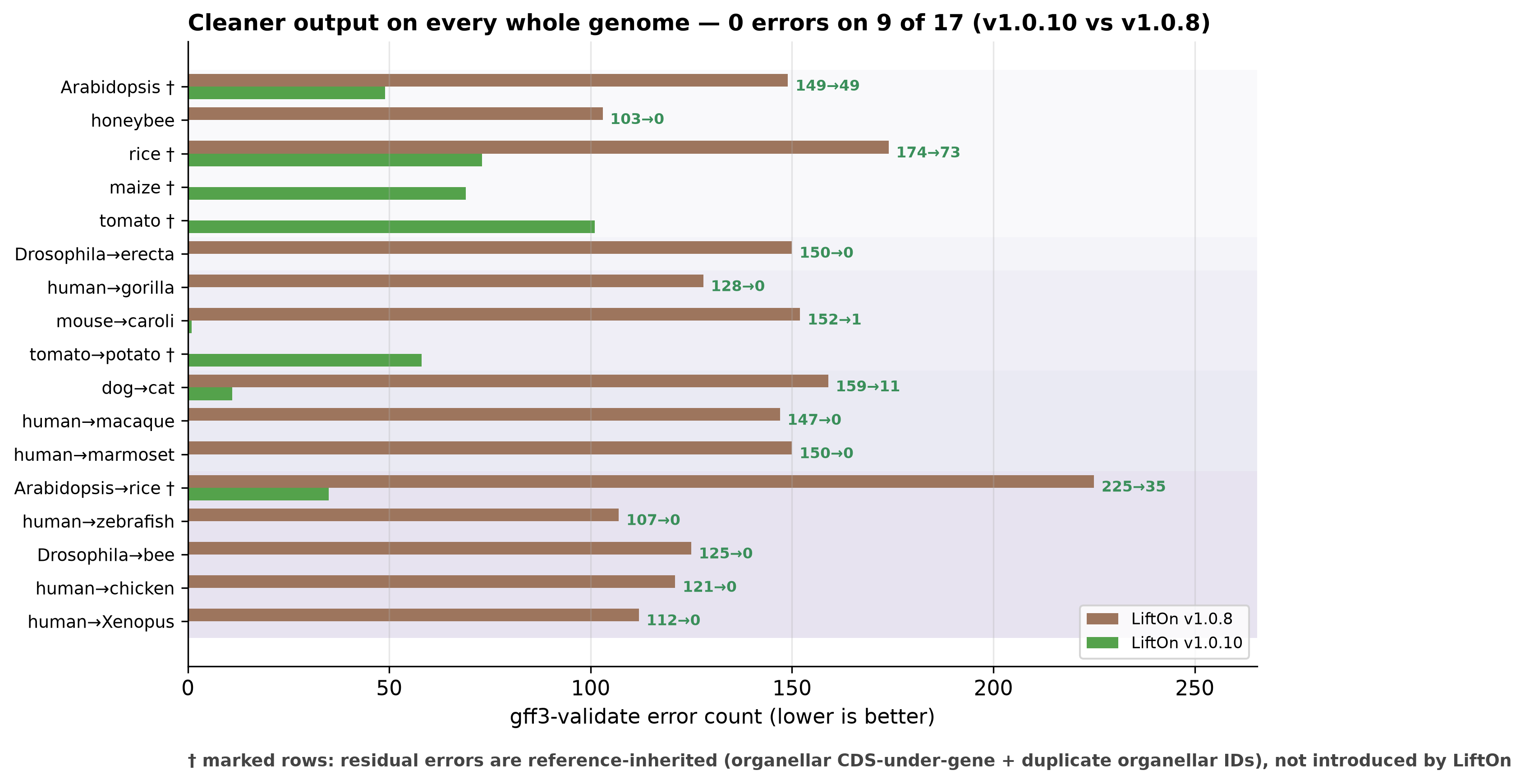
Figure 64 gff3-validate error count per whole genome, LiftOn v1.0.8 vs v1.0.10;
lower is better.
Performance
v1.0.10 ships byte-identical performance fast-paths — memory-bounded windowed alignment for giant genes, concurrent Liftoff‖miniprot execution, a fused per-locus thread pool, a collapsed sequence-extraction query, and block-at-a-time GFF3 validation. These change how LiftOn runs, never what it emits (pinned by a 24-cell byte-identity test matrix).
On a controlled single-thread arm with cached aligner inputs, which isolates LiftOn's own execution, v1.0.10 uses up to ~24× less peak memory than v1.0.8 and runs up to ~1.9× faster. The memory win is largest on giant-gene genomes (honeybee 10.9 GB → 0.45 GB; mouse→rat 10.6 GB → 0.49 GB) and is what removes the multi-gigabyte peaks entirely: on the mouse subset v1.0.10 peaks at 0.76 GB against v1.0.8's 44.6 GB, and it holds the lowest peak of any tool on 16 of the 23 subsets — even though it runs both Liftoff and miniprot internally.
The trade on a fresh whole-genome run is worth stating plainly: v1.0.10 does more computation per genome than v1.0.8 — it scores an extra merge candidate per transcript and lifts the full gene-like feature set beyond protein-coding genes — so peak memory still falls sharply while end-to-end wall time can rise on the genomes both versions complete. The decisive point is that the bounded memory is what makes whole-genome runs possible on commodity hardware at all: v1.0.8 could not finish Arabidopsis or rice regardless of how long it ran.
Adding --threads N --locus-pipeline (also byte-identical) reduces wall-clock
further.
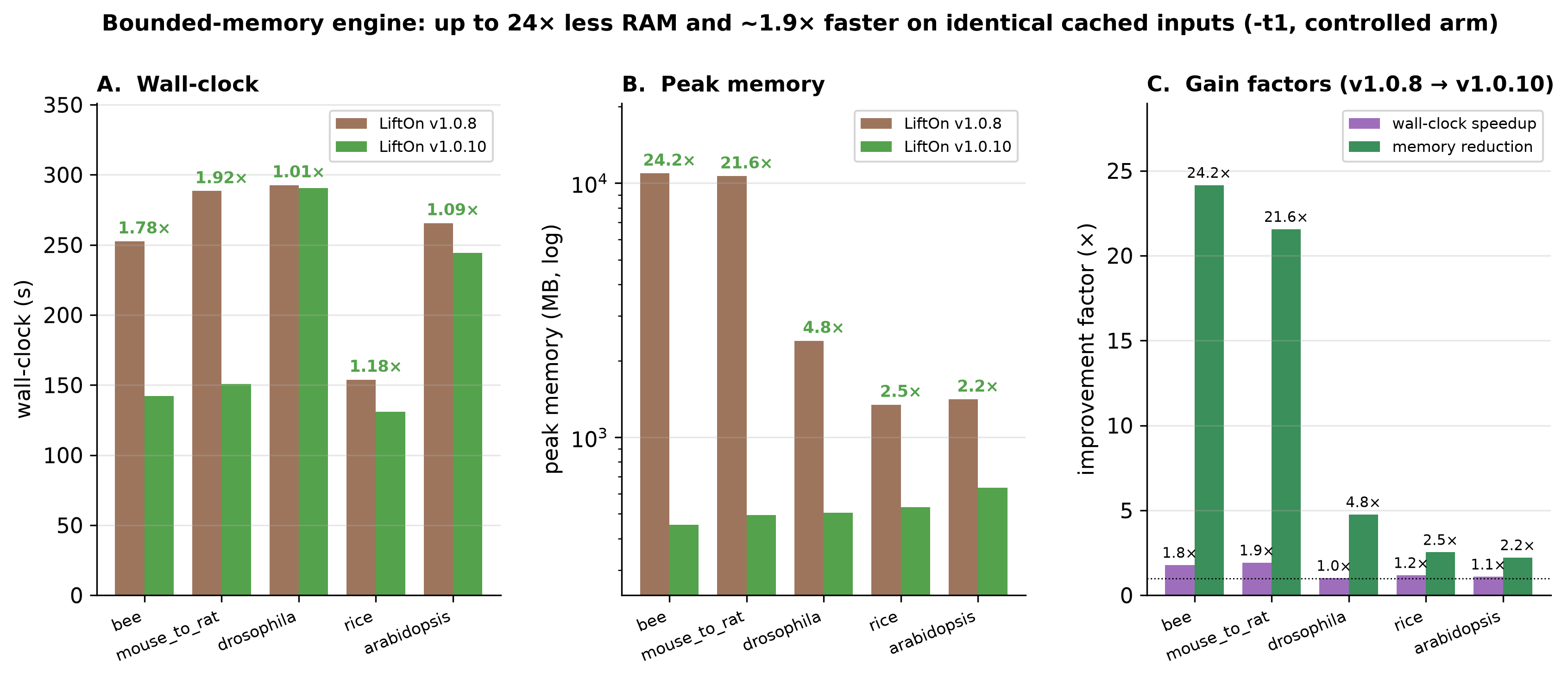
Figure 65 LiftOn v1.0.8 vs v1.0.10 on identical cached aligner inputs at -t 1. A:
wall-clock. B: peak memory (log scale). C: per-dataset gain factors
(wall-clock speedup and peak-memory reduction).
See the Changelog for the full list of v1.0.10 changes and their opt-out flags, and the User Manual for every command-line option.

